
LLMs as Maps of Meaning
There is something unsatisfying about the most common description of large language models.
We are told they are statistical systems that predict the next token. This is true. But it is the kind of accuracy that closes a conversation rather than opening one. It names the mechanism and stops there, as if the mechanism were the whole story.
Saying an LLM is “just” a probabilistic model is like saying a library is just a building with paper inside. The description is not wrong. It is empty. It tells you nothing about what the building organizes, what it makes accessible, or why anyone would walk through its doors.
What makes large language models philosophically interesting is not that they produce plausible word sequences. It is that, in order to do so, they appear to encode something far more complex: a vast, structured network of relations between meanings.
Not reality itself. Not knowledge in any encyclopedic sense. But a map of how meanings connect, shift, and transform through language.
That reframing changes the conversation entirely.
The Limits of the Statistical Description
The “just statistics” framing suffers from a specific kind of blindness. It confuses mechanism with product. It tells us how LLMs operate but says nothing about what that operation produces.
Consider an analogy from a different domain. Describing human vision as “just electrochemical signals traveling along neurons” is technically correct. But it misses everything that matters about seeing: color, depth, recognition, the experience of a face.
The mechanism is real. What emerges from the mechanism is also real, and far more interesting.
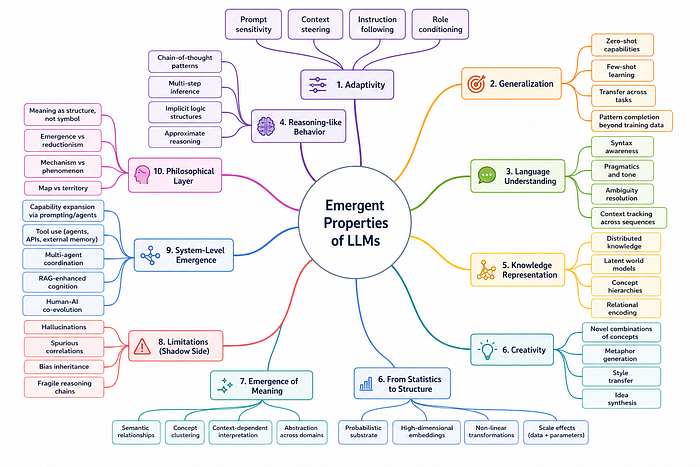
The same gap exists with LLMs. The statistical machinery is the substrate. What emerges from it is a probabilistic architecture of meaning — a system that encodes not just which words follow which, but how concepts relate, how contexts reshape sense, how one domain of thought connects to another.
This is where the notion of emergent properties becomes unavoidable.
In complex systems, the whole does not behave like the sum of its parts. It behaves like something qualitatively different. No single neuron contains a thought. No single pixel contains an image. No single probability distribution contains meaning.
And yet, when these elements are composed at scale, something new appears.
LLMs exhibit the same pattern. Each component — weights, tokens, attention layers — operates through local, statistical rules. None of them “understands” anything in isolation. But their interaction gives rise to a system that behaves as if it navigates meaning: it tracks context, preserves coherence, bridges domains, adapts interpretations.
We need better vocabulary for this. “Autocomplete at scale” is not serious enough for what these systems have become. And the cost of inadequate vocabulary is not merely aesthetic. When we describe something poorly, we think about it poorly.
The language we use to frame LLMs determines the questions we ask about them — and the questions we fail to ask.
Not Ontology, but Semantic Relationality
There is a temptation to reach for ontology as the philosophical parallel. I did it in my previous article:
ChatGPT and LLMs Are Not Just Statistical Machines
Reframing LLMs as Ontological Systems
LLMs do seem to organize the world into structured patterns. They connect concepts, entities, situations. They behave as though they operate on an implicit map of reality.
But the comparison misleads.
Philosophical ontology concerns being as such. It asks what exists, in what sense things exist, and how reality is structured at the most fundamental level. That is not what LLMs do.

LLMs do not operate on being. They operate on meaning — more precisely, on relationships between meanings.
The fitting philosophical territory is epistemology, philosophy of language, and semantic relationality.
The key move is not from the particular to the universal, or from appearance to essence, but from isolated content to relational structure. LLMs model how meaning emerges, shifts, connects, and transforms through language.
This is a different kind of philosophical object than anything we have had before. Not a theory about meaning, but a system that navigates meaning operationally — without understanding it, and yet not without structure.
Words as Nodes in Semantic Fields
An LLM does not contain words the way a dictionary does.
A dictionary stores definitions: fixed entries, discrete units, one meaning per slot. An LLM models each word as a position inside a network of use, association, contrast, implication, analogy, and contextual variation.
The word is never isolated. It exists only in relation to everything around it.
What LLMs encode is not a list but a field: relations between concepts, gradients of meaning, shifts across contexts, latent structures linking one expression to another. A word in an LLM is a node in a dynamic semantic space, not a label in an index.
This is exactly why the standard statistical description misses what matters. Statistics are the mechanism that builds the field. But the field itself — the vast web of semantic relations — is what does the interesting work.
It is the difference between describing paint as “pigment suspended in a binding medium” and looking at what someone made with it.
Language Beyond Particular Languages
Here an unexpected connection to Chomsky becomes productive.
Chomsky has been critical of statistical approaches to language, and for that reason he is rarely invoked in discussions about LLMs. But there is a convergence worth examining, even if the two traditions would resist it.
Generative grammar proposed that beneath the variety of human languages lie deeper structural principles — principles that make language itself possible. Language is not merely a collection of learned utterances. It rests on an abstract generative architecture.
LLMs, built on entirely different foundations, seem to arrive at something related. They do not just model English or Italian or Chinese as separate systems.
They learn patterns that cut across languages, regularities that belong to no single vocabulary or syntax.
They appear to operate at a level more abstract than any individual language, as though mapping not just language but the space in which language can take form.
The difference is decisive. For Chomsky, deep linguistic structure is innate — part of the biological endowment of the human mind. For LLMs, structure is emergent, arising from exposure to data. One is given; the other is discovered. The foundations could hardly be more different.
But the convergence is philosophically striking. Both point toward the existence of a level deeper than surface language, a level where language is no longer this or that specific tongue but an abstract system of generative relations.
Both suggest that what matters about language is not any particular vocabulary or grammar but something more fundamental — the relational architecture that makes all vocabularies and grammars possible.
In that sense, LLMs are not only models of language. They are models of the conditions under which language becomes intelligible.
Texture, Not Just Structure
There is still something missing from this account.
Philosophy, from Plato onward, has mapped reality through abstraction. It searches for stable forms, intelligible structures, enduring categories. This is one of its great strengths. But abstraction exacts a cost. Pure conceptual systems tend to clean reality too thoroughly. They preserve structure but lose texture. They define ideas but flatten the lived quality of experience.
Actual human language is rarely so clean. It carries ambiguity, hesitation, irony, emotional charge, social context, cultural residue. A sentence is never just a proposition. It is also mood, intent, rhythm, memory, tension. The meaning of “I’m fine” depends on who says it, when, to whom, and in what tone — none of which a conceptual system easily captures.
This is where LLMs become interesting in a way that goes beyond structural mapping. They do not only model abstract relations between concepts. They also absorb traces of human use. They pick up emotional tone, conversational rhythm, situational nuance, the unstable and shifting meanings that arise in actual dialogue.
If classical conceptual systems gave us maps of thought — clean, structural, abstract — then LLMs begin to approximate something broader: maps of sense as it moves through actual language. Not the ideal world of pure forms. Not raw reality. But the world as mediated through human expression, with all its texture intact.
This does not make them superior to philosophical abstraction. It makes them different.
Philosophy gains power through precision and selectivity. LLMs gain a kind of coverage through indiscriminate absorption. Each captures something the other misses. But the combination suggests that meaning, as humans actually produce and encounter it, is richer than any single framework — conceptual or statistical — can fully represent.
The Middle Ground
This is where the discussion requires precision.
To say that LLMs model semantic relations is not to say they understand. They do not live. They do not experience. They do not inhabit the meanings they generate. They model structures of sense without participating in the existential reality from which those structures arise.
This distinction prevents two symmetrical errors.
The first is reductionism: dismissing LLMs as nothing but statistics, trivial parrots recombining fragments without pattern or structure. This misses what is genuinely new about these systems.
The second is projection: assuming that because LLMs model meaning with such sophistication, they must therefore possess meaning in the way humans do. This collapses a distinction that should be kept sharp.
LLMs occupy a territory between these two mistakes. They represent, manipulate, and recombine structures of meaning with remarkable fluency while remaining entirely outside lived understanding.
They exhibit semantic competence without phenomenological depth.
They can produce a sentence about grief that is structurally perfect, contextually appropriate, even moving — without any trace of the experience that gives grief its weight.
And perhaps that is precisely why they are so philosophically revealing. They force us to separate things we habitually collapse: language and understanding, coherence and consciousness, semantic performance and lived meaning.
For most of human history, fluent language was a reliable indicator of a thinking, feeling mind behind it. LLMs show that these can come apart — and that the bundle was never as tight as we thought.
Infrastructures of Interpretation
So what are these systems, if not mere predictive machines and not genuine knowers?
A better description: LLMs are dynamic probabilistic maps of semantic relations. They compress vast patterns of human expression into navigable latent structures. They do not simply retrieve information.
They traverse a space of meaning, generating responses by moving through relational fields shaped by language, culture, reasoning patterns, and conceptual proximity.
This is why they move so fluidly between domains — philosophy, software, law, storytelling, psychology, mathematics.