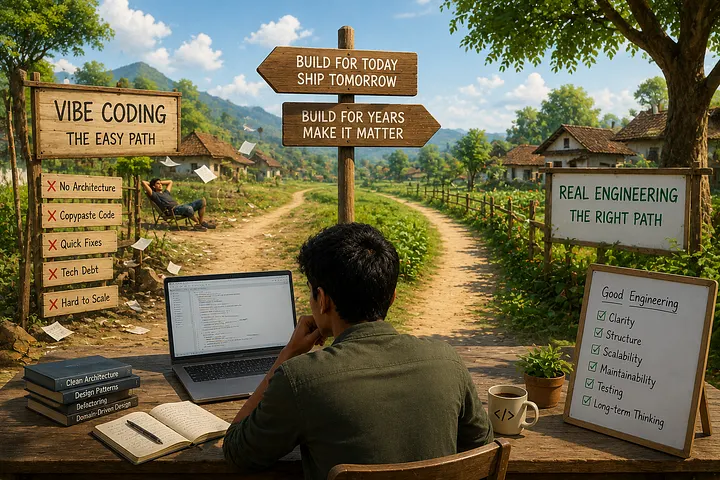
Fast code is easy. Maintainable software is still hard.
What Exactly Is “Vibe Coding”?
If you’ve been using Cursor, Claude Code, Copilot, or ChatGPT heavily, you already know what this feels like.
You stop thinking line-by-line.
Instead, you start operating on intention.
You describe what you want:
- “Create a reusable bottom sheet component.”
- “Convert this Swift screen into React Native.”
- “Add optimistic UI updates.”
- “Refactor this API layer using clean architecture.”
And suddenly… code appears.
A lot of code.
Sometimes surprisingly good code.
The experience feels addictive because it removes the slowest part of development: implementation friction.
You no longer spend 20 minutes remembering syntax or searching Stack Overflow for tiny issues. AI handles the repetitive mental load instantly.
This creates a dangerous illusion:
developers start feeling like software creation itself has become easy.
It hasn’t.
Only typing became easier.
Engineering is still hard.
That distinction is where many teams are getting into trouble right now.
AI Is Incredible at Local Decisions
This is something many developers still misunderstand.
AI is very good at solving isolated problems.
For example:
- generating UI components
- writing helper functions
- creating API models
- converting code between languages
- adding validations
- generating tests
- building CRUD flows
Honestly, it’s shockingly good at these tasks now.
I’ve used AI to:
- migrate iOS logic into React Native
- generate Redux reducers
- build reusable hooks
- create local database models
- speed up boring refactors
- generate documentation
Sometimes it saves hours.
Sometimes days.
But here’s the problem.
Software systems are not collections of isolated problems.
They are connected systems.
Architecture decisions affect future scalability. State management affects debugging complexity. Folder structures affect onboarding. Naming consistency affects maintainability.
AI is usually optimizing for:
“Does this piece of code solve the immediate problem?”
Senior engineers optimize for:
“Will this system still make sense after 18 months of feature additions?”
Those are completely different goals.
And that difference becomes painfully obvious in production apps.
The Dopamine Loop of AI Coding
The biggest danger of vibe coding isn’t bad code.
It’s the emotional feedback loop.
You prompt something.
AI responds instantly.
You see visible progress immediately.
Your brain gets rewarded.
Again and again.
Traditional development had friction:
- thinking
- planning
- architecture decisions
- debugging
- experimentation
AI compresses all of that into seconds.
This makes developers feel dramatically more productive.
Sometimes they actually are more productive.
But productivity without visibility becomes dangerous very quickly.
I’ve seen developers generate:
- entire authentication flows
- navigation systems
- database layers
- caching implementations
…without deeply understanding any of it.
That works fine until:
- performance drops
- edge cases appear
- production bugs happen
- API contracts change
- business logic evolves
Then suddenly the team realizes:
nobody truly owns the system anymore.
The AI generated it faster than humans mentally processed it.
The “Looks Correct” Problem
One of the most dangerous things about AI-generated code is that it often looks professional.
The formatting is clean.
Variable names are reasonable.
Functions are organized nicely.
It gives an illusion of correctness.
But software problems are rarely visual problems.
I once tested an AI-generated React Native feature where everything looked perfect initially.
Then we discovered:
- duplicate API calls during screen focus
- race conditions in async state updates
- unnecessary re-renders
- memory leaks from listeners
- inconsistent loading states
None of these were obvious from reading the code quickly.
The AI didn’t “fail” exactly.
It simply optimized for “working code,” not production-grade engineering.
That difference matters more than people realize.
Junior Developers Are Learning a Dangerous Habit
This is probably the part that worries me most.
Many junior developers are now skipping the struggle phase entirely.
That struggle used to teach:
- debugging
- architecture thinking
- problem decomposition
- code tracing
- dependency understanding
- tradeoff analysis
Now the workflow often looks like this:
- Prompt AI
- Paste code
- Fix errors
- Ship feature
The problem is:
fixing syntax errors is not engineering.
Understanding systems is engineering.
I interviewed a developer recently who could generate React components incredibly fast using AI.
But when I asked:
“Why did you choose this state structure?”
There was silence.
Not because the developer was unintelligent.
Because the decision was never actually made consciously.
AI made it implicitly.
That changes how developers learn.
And honestly, I don’t think the industry fully understands the long-term consequences yet.
