
The study doesn’t reveal a crisis — it documents AI’s normal learning curve, the same adoption bottlenecks that shaped PCs and the internet.
You’ve seen this MIT study. Or at least you heard people talk about how 95% of organizations are getting zero return. Your LinkedIn feed is full of people sharing it with knowing nods, saying “I told you so” about the AI hype bubble.
Meanwhile, McKinsey and other consultancies are much more positive about the GenAI usage in the enterprise.
All these statistics are correct.
The issue here is that most people (even some AI celebrities/ scholars) are getting lost in the nuances of economic terms, worse, completely missing the entire point of how technology adoption actually works.
The MIT report measured “intensive margin” adoption. This means full production deployment with measurable KPIs and ROI impact measured six months post-pilot. This is like asking, “How deeply are you using it?”
Whereas the McKinsey one measured “extensive margin” adoption, which is when organizations use AI in at least one business function, regardless of scale or measurable impact. Think of this as asking, “Are you using it at all, anywhere?”
These aren’t contradictory findings.
They’re documenting different phases of the same inevitable process that has played out with every transformational technology for the last 40 years.
What actually matters is that while you’re debating success rates, marginal economic gains are pushing everyone toward adoption, whether they want it or not.
You need to see past the 95% rate as a warning about AI.
It’s confirming how AI is following the exact same adoption pattern as personal computers and the internet.
I’ve been emphasizing the harms and risks of adopting AI, knowing more than 24.1% of risks from human mistakes, intentional or not. Still, all of us need to adopt AI one way or another… which I’ll explain below.
TLDR
- Q: What did the MIT study really find about AI projects?
The MIT “GenAI Divide” study found that around 95% of enterprise generative AI pilot projects fail to deliver measurable business results or progress beyond early stages, despite billions invested. Most failures happen because organizations get stuck in endless pilots, struggle with integration, or focus on flashy experiments over deep process change. - Q: Is AI adoption still racing ahead despite these failures?
Yes. Companies and individuals still embrace AI tools to capture even small productivity gains, even as most major projects stall. The pace of adoption is relentless because marginal benefits, competitive pressure, and network effects drive widespread use, regardless of overall project success rates. - Q: Where are we now in the history of AI adoption compared to other technologies?
AI is at the pilot phase, like PCs and the internet during their early decades, with high failure rates and immature best practices. These failures are typical for transformative technologies. - Q: Does everyone have a choice about adopting AI?
No. The landscape is shaped by millions of individual and organizational decisions, creating irreversible competitive dynamics. Even if everyone sees the risks, holding back isn’t viable. The only move is to experiment early, position for future change, and learn from current mistakes.
Shall we?
The Confusion Comes From Measurements
Let me explain how marginal economic gains drive adoption despite project failure rates, because this is where most people get confused.
Just like when you discover that ChatGPT can cut your email writing time in half, you adopt it.
When a marketing team finds that an AI tool can generate first drafts 60% faster than starting from scratch, they adopt it; or when a developer realizes GitHub Copilot reduces coding time by 20%, they adopt it…
None of these adopters cares about their company’s “AI transformation project” success rate.
They care about making their Tuesday afternoon less miserable.
Essentially, McKinsey’s survey counted organizations that “use AI in at least one business function.” They counted the same number when a person in a company used ChatGPT for email drafts as when a company had rebuilt its entire customer service operation around AI.
The aggregate result is the 70%+ adoption rates you read in many consulting firms’ reports. Emerges from millions of individual decisions about small productivity gains, not the same as boardroom strategies about digital transformation.
Meanwhile, the 95% failure rate captures something completely different; they defined success as
- “Company-wide projects attempting to restructure business processes around AI”,
- “deployment beyond pilot phase with measurable KPIs,” and
- “ROI impact measured six months post-pilot.” Requires deep integration that transforms business processes and delivers quantifiable returns.
Worth mentioning, this is a report with a small sample size, 52 organizations, 153 leaders, four industries — directional, not definitive.
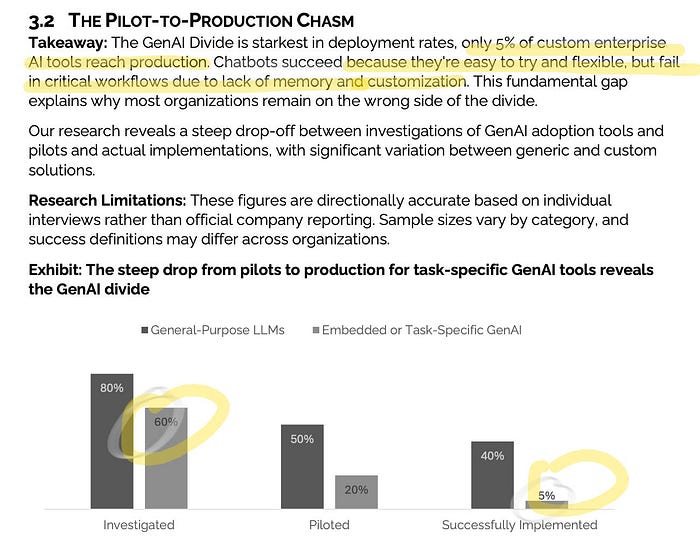
These projects fail because they aim for full production deployment in at least one department across the entire organization. This requires infrastructure, training, process redesign, and cultural change, which no digital transformation project could ever complete within 6 months.
However, for technology to become inevitable, you do not need a deep cooperate integration. Basic usage across many functions, even just like using ChatGPT for a sales pitch, creates competitive pressure that forces deeper adoption over time.
The economic logic is straightforward. Individual shallow adoption has low switching costs and immediate marginal benefits.
While enterprise-level adoption requires significant infrastructure investment, process redesign, and organizational change, most companies can’t execute effectively. I ran a consolidation program across three continents and dozens of countries, just planning and trying to get a go from the C-level team took 6 months…
But even the shallow, individual-level adoption creates competitive pressure that eventually forces enterprise adoption among market leaders, which then creates further pressure for broader intensive adoption.
What History Tells Us About Tech Adoption
There is no need for handwaving or metaphors. Consider what happened with personal computers or the Internet.
No Clear ROI For PC Adoption Before the 1970s’
Using the same standard as this MIT report, most corporate PC implementations in the 1980s failed by any reasonable metric.
Companies spent millions on hardware and software that sat unused, training programs that employees ignored, and ambitious productivity improvement projects that delivered no measurable ROI.
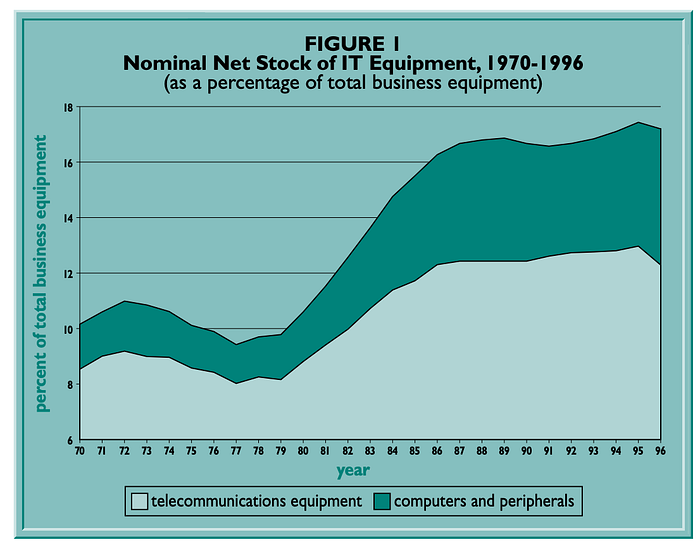
So, reading this 1999 paper (Computers and Productivity in the Information Economy), you’d quickly see two things: one, the total business IT equipment nearly doubled from the 1970s to the 1990s.
Second, the manufacturing productivity went sideways after computers hit the scene, even as IT investment exploded.
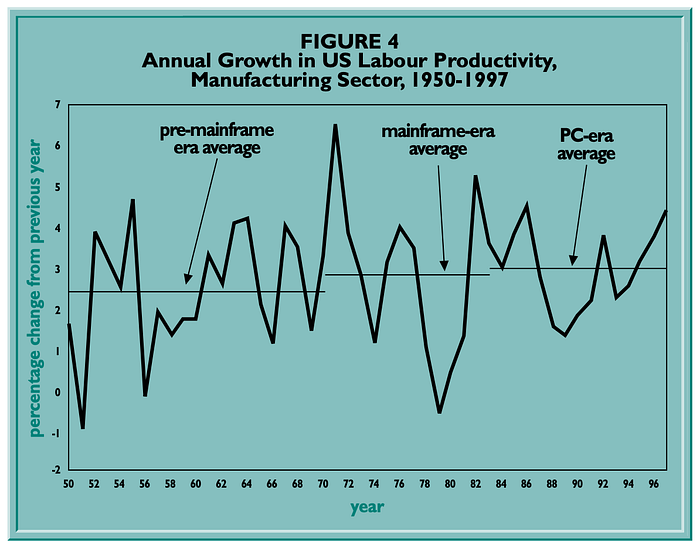
If you’re using the MIT GenAI study as proof that AI projects “don’t work,” here’s the evidence of why this is perfectly normal.
Yet by 1995, not having PCs was competitively impossible because enough individual workers and departments had found marginal benefits that non-adopters couldn’t compete.
A few interesting comments in this 30-year-old study I’d like to share with you:
These examples serve to illustrate that computers are powerful tools, but they can very easily be used in a less than-optimal manner. By facilitating tasks such as document composition and layout and bibliographic searching for non-specialists, they can undermine the economic efficiencies that result from the pure specialisation of labour
Sounds familiar? Or this, which is more like a universal economic truth. Still, people tried too hard using a computer (in the 90s) or AI (such as agentic) to justify the spending for the sake of chasing the latest technology.
As long as the benefits of additional computer investment exceed the benefits from investing such resources elsewhere, firms should continue to invest in computers. Beyond a certain threshold, benefits will diminish to the point that further computer investment is a losing proposition.
How about this?
The PC era may have initially promised more than it could deliver, to the detriment of computer investment strategies…
You’re likely bored with the dotcom example, so let me try something else.
A 2005 MIT study used various technology projects as examples, trying to find out the correlation between successful IT projects and other factors (like other complementary settings available)
The second lesson to be drawn relates to the length of time the process took to work through into the productivity transformation of the late 1990’s. Notwithstanding the rapid fall in computer and ICT prices, the interplay between the competitive and regulatory environment and the successful WalMart strategy took decades to emerge. The bar code patent dates from 1949 but the first retail product was not scanned at a checkout until 1975.
